the cozm logo
Global Mobility Event
September 30, 2026

The Tools Are Here. The Method Comes Next.

The first commercial typewriter went on sale in 1874. The technique that made it transformative did not arrive until 1888.

For those fourteen years, most people used the machine in the obvious way: hunting for each key, eyes moving constantly between keyboard and page. It was quicker than handwriting, and that was about all anyone could say for it.

Then, on 25 July 1888, a court stenographer named Frank McGurrin took part in a public typing contest in Cincinnati against a rival typist, Louis Traub. McGurrin had taught himself to type without looking at the keys — he had memorised the keyboard, and kept his eyes on the copy he was transcribing. He won decisively, and the method he demonstrated spread from there into schools and commercial colleges.

The productivity leap everyone credits to the typewriter did not come from the typewriter. It came from a method, invented by one person, proved in public, and then taught.

Global mobility is in the equivalent of those fourteen years with AI. The tools are on the desk. Most people have an account. Very few have been shown a method — how to brief a task properly, what to check before trusting an output, which jobs to hand over and which to keep. So they try it, get a mediocre result, and conclude the technology was oversold.

The technology was not oversold. The training simply has not happened yet.

What closes the gap is unglamorous. One real task you do every week. Twenty minutes on it, regularly. A note of the briefs that worked. Someone better than you to watch. And a tolerance for being slower before you are faster, because every change of method costs something before it pays.

None of that requires permission, budget, or a transformation programme. It requires deciding that being a beginner again is acceptable.

AI in Mobility is The Cozm's online forum for mobility professionals. Session 1, Automation of Global Mobility, runs on Monday 26 October at 15:00 UK, covering what can be automated, where human judgement still matters, and the skills worth building for 2027. Session 2, on international project workers, follows on Wednesday 18 November.

Request a place at thecozm.com/events/ai-in-mobility.

More Insights

See All
banner

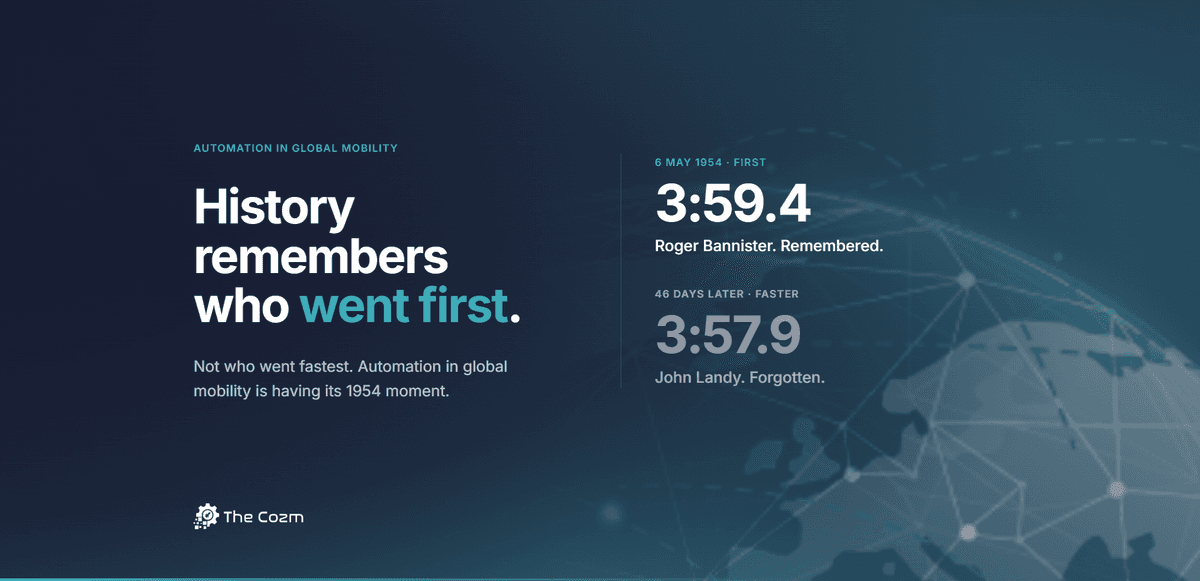
History remembers who went first

October 21, 2026
ComplianceCompany newsTechnology

On 6 May 1954, Roger Bannister ran the first mile under four minutes. Everyone remembers that. Forty-six days later, in Turku, Finland, John Landy ran it faster, in 3:57.9. Almost nobody remembers him. Within a few years, dozens of runners had broken four minutes. Two lessons come from one race. Once someone proves a thing can be done, the field moves quickly. And history remembers who went first, not who went fastest. I have been thinking about Landy this week for two reasons. A year ago I came out of retirement, after 17 years as a Big 4 global mobility partner, to join The Cozm. And last week our CEO, Ben Oghene, was named Global Mobility Professional of the Year at the FEM EMEA EMMAs. That matters beyond our team. A global mobility professional was recognised not for advising around the problem, but for building the thing that fixes it. Four lessons from my first year back: Most "complex" mobility work is a rule nobody has written down. Writing it down is most of the work of automating it. Pilot before you write the policy. Three weeks of live trips will teach you more than three months of workshops. The real question is not "can this be automated?" but "who owns the decision once it is?" Clients do not buy technology. They buy certainty. The technology is how you deliver it at scale. Automation in global mobility is having its 1954 moment. The proof is there, and the field is about to move. The teams that go first will be the ones people remember. The rest risk being John Landy: faster, but forgotten. If you want to see what going first looks like, join our first AI in Mobility session, "Automation of Global Mobility", on Monday 26 October at 15:00 UK. Details and places are at thecozm.com/events/ai-in-mobility.
Read more
banner

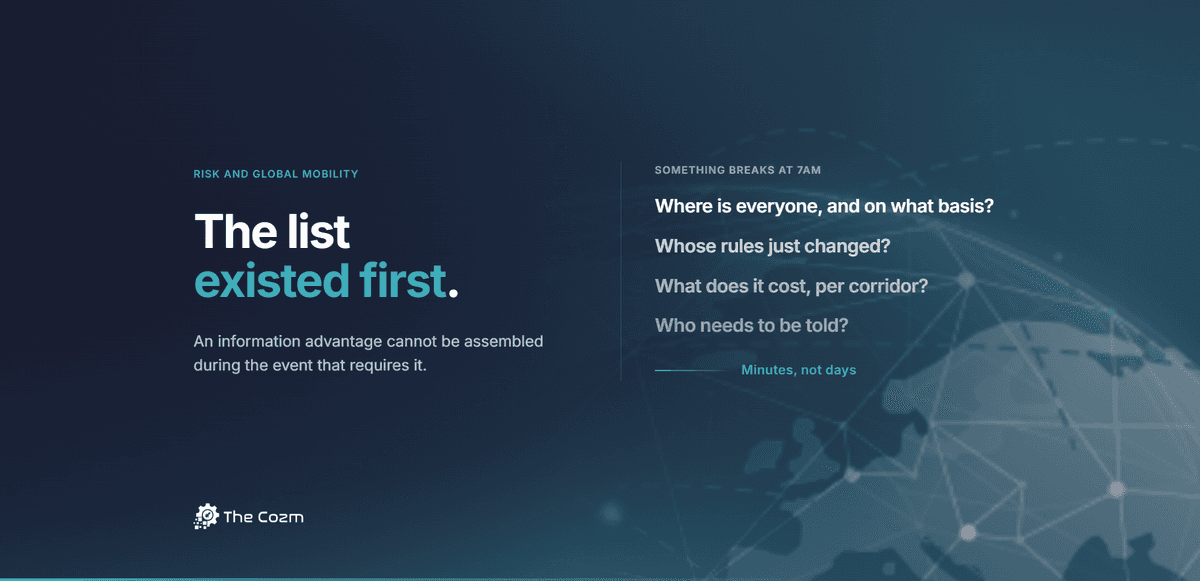
Global Mobility Needs Its Own Lloyd’s List

September 23, 2026
TechnologyCompliance

In 1686 Edward Lloyd opened a coffee house near the Thames. What made it the most important room in London was not the coffee. Lloyd began collecting shipping intelligence — which vessels had sailed, which were overdue, which had been taken or lost — and circulating it among the merchants and underwriters who gathered there. By 1734 it had become Lloyd's List, which is still published today. Those merchants traded through war, blockade, privateering and weather, with no way of seeing over the horizon. The ones who prospered were not braver than their competitors. They had better information, sooner. That is what an information advantage buys: not certainty, but the ability to price a risk that everyone else has to decline, and to keep moving while others wait for news. Global mobility now operates in a comparable world. Tariffs redraw supply chains, and headcount follows them. Immigration policy is tightening towards local hiring in market after market. Sanctions and conflict close corridors with little notice. None of it is forecastable. All of it is survivable, provided you can see your own position clearly and quickly. The test is simple. When something breaks at seven in the morning, how long does it take to answer four questions? Where is every mobile employee, and on what legal basis are they there? Which of them are in a country whose rules have just changed? What does that change cost, per person and per corridor, and how fast can it be re-modelled? And who needs to be told, with evidence that they were told? If the honest answer involves several days and a spreadsheet, that is not a resourcing problem. It is the absence of a list. The uncomfortable part is that an information advantage cannot be assembled during the event that requires it. The merchants at Lloyd's did not begin collecting shipping news on the morning the fleet failed to arrive. The list existed first, which was the entire point. Keeping your head when those around you are losing theirs is not a character trait. It is knowing something they do not.

Read more
banner

It Was Never the Tool. It Was the Brief.

September 16, 2026
TechnologyCompliance

In 1864, Charles Babbage recorded a complaint. Twice, he wrote, he had been asked by parliamentarians — once in each House — whether, if you put wrong figures into his calculating machine, the right answers would come out. He replied that he was not able rightly to apprehend the kind of confusion of ideas that could provoke such a question. A hundred and sixty years later we have machines Babbage could not have imagined, and we are still asking his question. We have simply stopped noticing that we are. Global mobility teams have spent two years being told that AI will transform the function. Many have tried it. They have typed a short instruction into a box, received a generic summary of a policy they wrote themselves, and concluded the technology was oversold. The conclusion is understandable and it is wrong. The variable was never the model. It was the brief. The difference between people getting real value out of these tools and people getting filler is rarely the tool. It is the quality of the input — and that is a learnable skill, not a technical one. Five things change the output immediately. Brief it the way you would brief a new joiner. Nobody tells a first-day hire to "sort the tax thing", so give the role, the situation, the constraints and the audience. Say what good looks like. "A one-page note a CFO will read" produces something entirely different from "explain this". Show it a single example of a strong output. That teaches more than three paragraphs describing one. Ask it to interview you before it answers. "What do you need to know first?" is the fastest way to learn what a good brief contains. Treat the first response as a draft rather than a verdict. The value usually arrives on the second or third pass. None of this requires a course or a licence. It requires the discipline of asking properly, which mobility professionals already practise every time they turn a vague request from the business into a workable instruction. The people who get the most from AI over the next two years will not be the ones with the best tools. They will be the ones who got good at asking.

Read more
banner

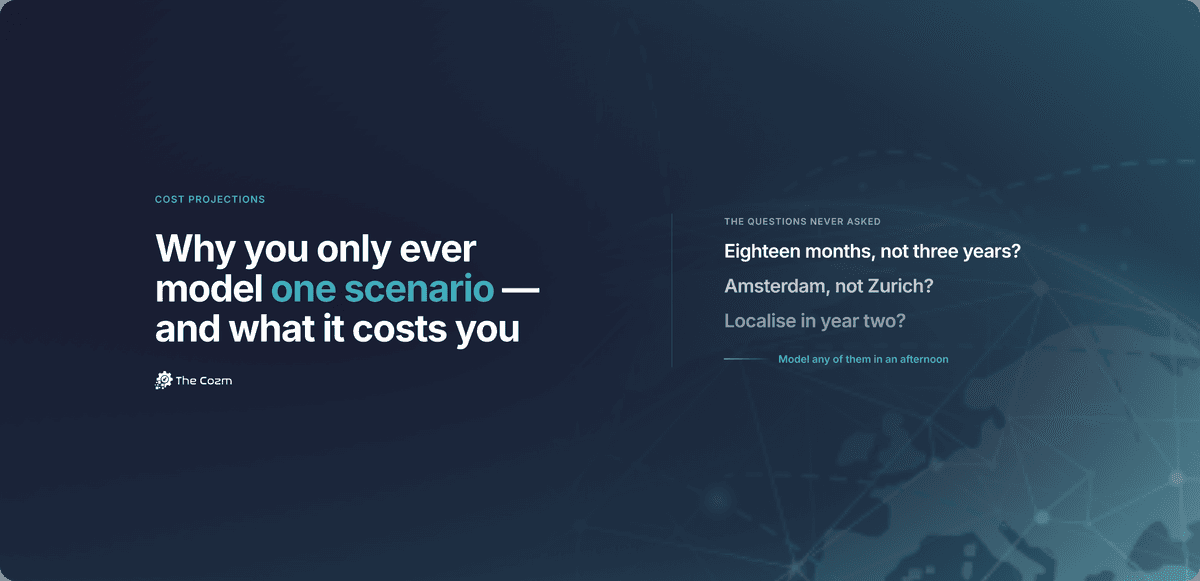
Why you only ever model one scenario — and what it costs you

September 2, 2026
ComplianceTechnologyCompany news

In 1975 an engineer at Kodak assembled the first digital camera. It weighed nearly four kilos and took 23 seconds to record a single black-and-white image onto a cassette tape. By every measure of the day, it was worse than film. What eventually changed photography was not image quality. It was that the marginal cost of one more photograph fell to nothing. When a roll of film cost money to buy and money to develop, you framed carefully, took one shot and hoped. Once the second attempt was free, people did not simply take the same pictures more cheaply. They took more of them, looked, and tried again. The photographs got better because failure stopped being expensive. Assignment cost projections are still in the film era. Ask for one and, in most organisations, there is a fee attached and a wait of several days. That pricing shapes behaviour long before anyone reads the number. Because each scenario costs something, teams model one — and it is almost always the scenario the business has already settled on. The projection becomes a confirmation exercise rather than a decision tool. The questions that never get asked are the valuable ones. What if this is eighteen months rather than three years? What does the same package cost in Amsterdam instead of Zurich? What if we localise in year two rather than extending? What if the family joins later? Any of those could change the answer materially. None of them get modelled, because each one carries a price tag and a lead time. So the real cost of an expensive cost estimate is not the invoice. It is the alternatives nobody tested, and the decision that was taken without them. The fix is not to negotiate a better rate per projection. It is to move the cost of asking towards zero, so that modelling a scenario is something a mobility manager does in an afternoon rather than something they have to justify requesting. Get that right and the question changes — from "what will this assignment cost?" to "which version of this assignment is the right one?"

Read more