History remembers who went first
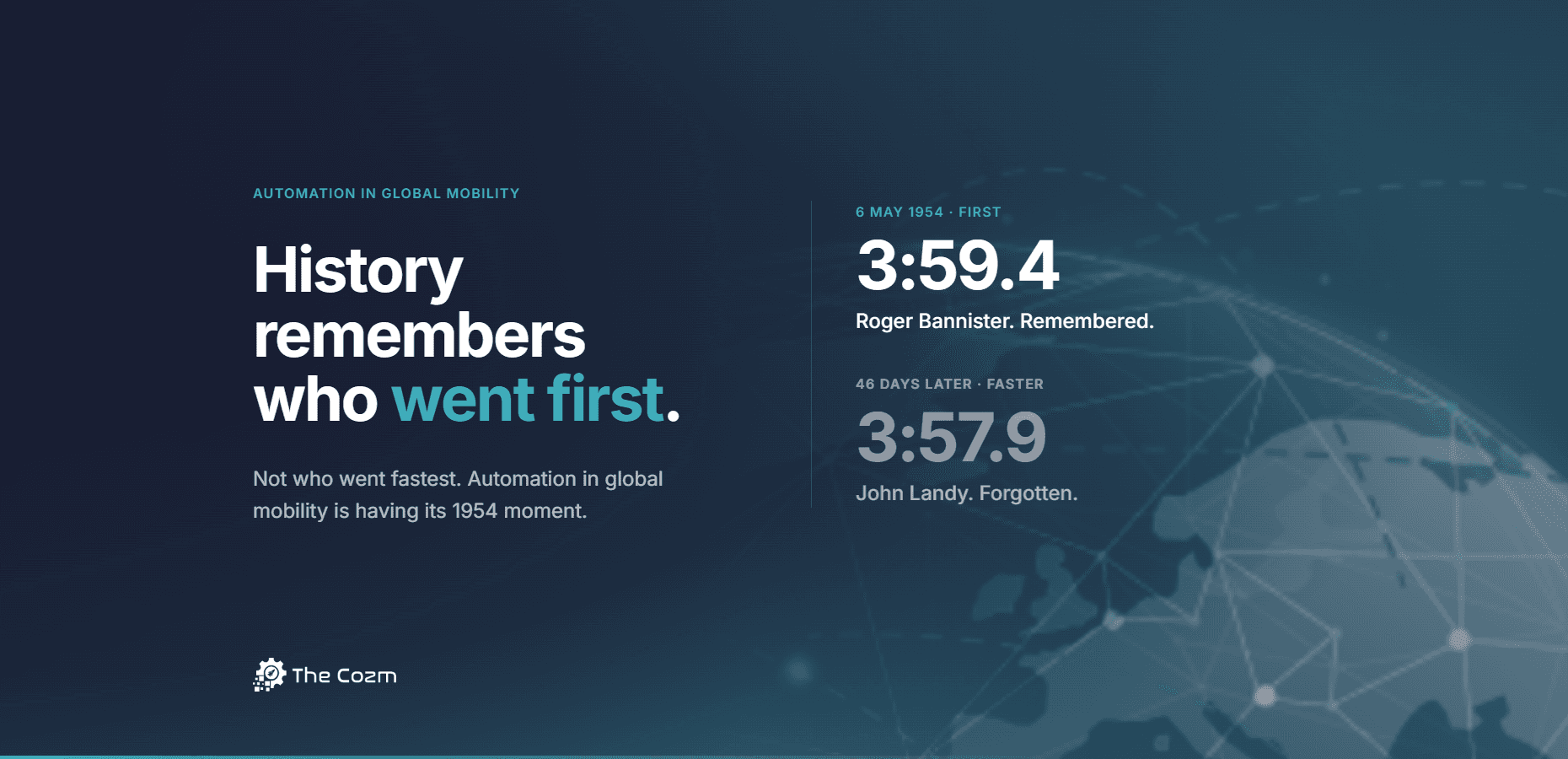
On 6 May 1954, Roger Bannister ran the first mile under four minutes. Everyone remembers that. Forty-six days later, in Turku, Finland, John Landy ran it faster, in 3:57.9. Almost nobody remembers him. Within a few years, dozens of runners had broken four minutes.
Two lessons come from one race. Once someone proves a thing can be done, the field moves quickly. And history remembers who went first, not who went fastest.
I have been thinking about Landy this week for two reasons. A year ago I came out of retirement, after 17 years as a Big 4 global mobility partner, to join The Cozm. And last week our CEO, Ben Oghene, was named Global Mobility Professional of the Year at the FEM EMEA EMMAs. That matters beyond our team. A global mobility professional was recognised not for advising around the problem, but for building the thing that fixes it.
Four lessons from my first year back:
Most "complex" mobility work is a rule nobody has written down. Writing it down is most of the work of automating it.
Pilot before you write the policy. Three weeks of live trips will teach you more than three months of workshops.
The real question is not "can this be automated?" but "who owns the decision once it is?"
Clients do not buy technology. They buy certainty. The technology is how you deliver it at scale.
Automation in global mobility is having its 1954 moment. The proof is there, and the field is about to move. The teams that go first will be the ones people remember. The rest risk being John Landy: faster, but forgotten.
If you want to see what going first looks like, join our first AI in Mobility session, "Automation of Global Mobility", on Monday 26 October at 15:00 UK. Details and places are at thecozm.com/events/ai-in-mobility.