Global Mobility Needs Its Own Lloyd’s List
In 1686 Edward Lloyd opened a coffee house near the Thames. What made it the most important room in London was not the coffee. Lloyd began collecting shipping intelligence — which vessels had sailed, which were overdue, which had been taken or lost — and circulating it among the merchants and underwriters who gathered there. By 1734 it had become Lloyd's List, which is still published today.
Those merchants traded through war, blockade, privateering and weather, with no way of seeing over the horizon. The ones who prospered were not braver than their competitors. They had better information, sooner. That is what an information advantage buys: not certainty, but the ability to price a risk that everyone else has to decline, and to keep moving while others wait for news.
Global mobility now operates in a comparable world. Tariffs redraw supply chains, and headcount follows them. Immigration policy is tightening towards local hiring in market after market. Sanctions and conflict close corridors with little notice. None of it is forecastable. All of it is survivable, provided you can see your own position clearly and quickly.
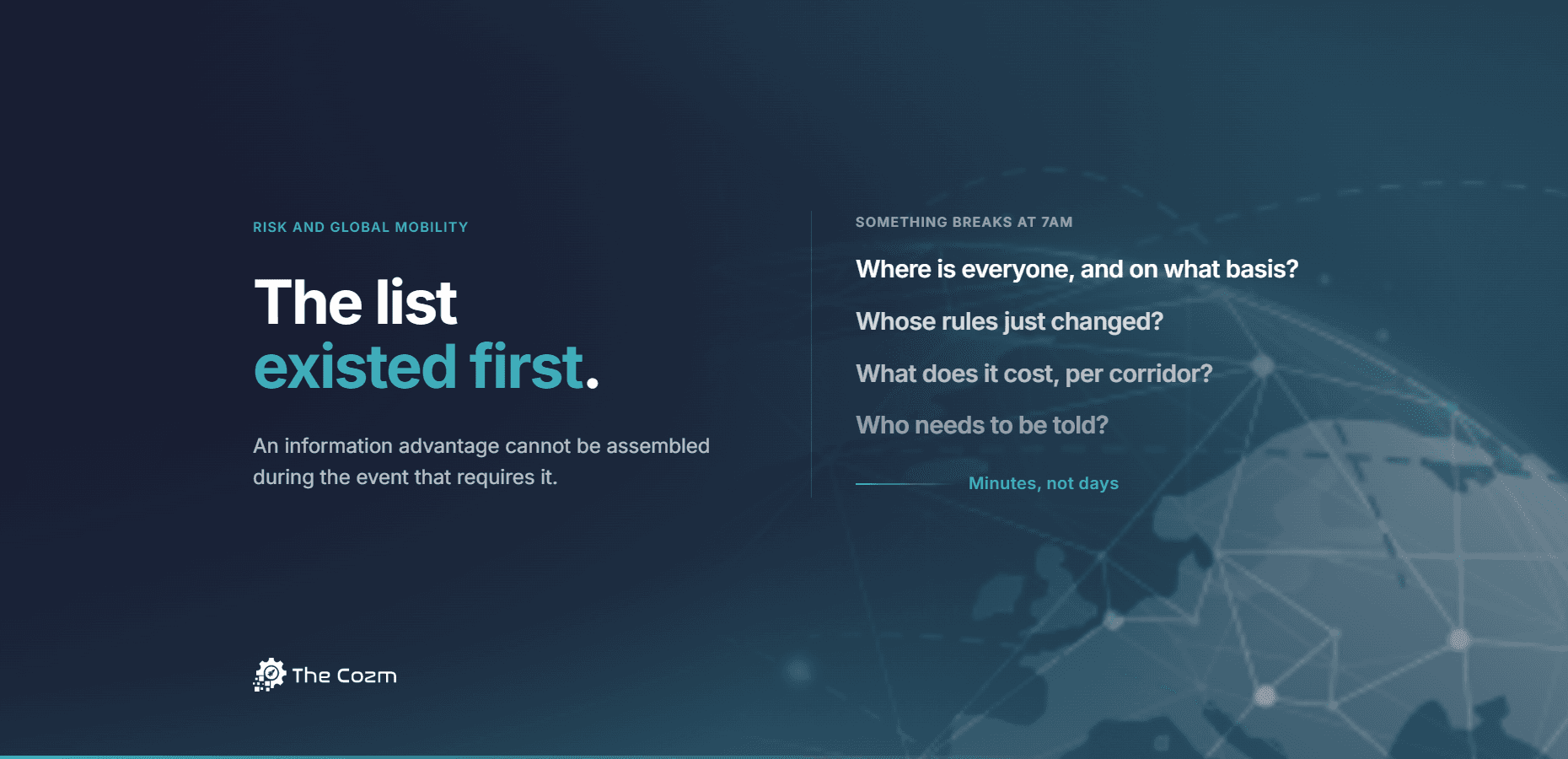
The test is simple. When something breaks at seven in the morning, how long does it take to answer four questions? Where is every mobile employee, and on what legal basis are they there? Which of them are in a country whose rules have just changed? What does that change cost, per person and per corridor, and how fast can it be re-modelled? And who needs to be told, with evidence that they were told?
If the honest answer involves several days and a spreadsheet, that is not a resourcing problem. It is the absence of a list.
The uncomfortable part is that an information advantage cannot be assembled during the event that requires it. The merchants at Lloyd's did not begin collecting shipping news on the morning the fleet failed to arrive. The list existed first, which was the entire point.
Keeping your head when those around you are losing theirs is not a character trait. It is knowing something they do not.