the cozm logo
Global Mobility Event
September 2, 2026

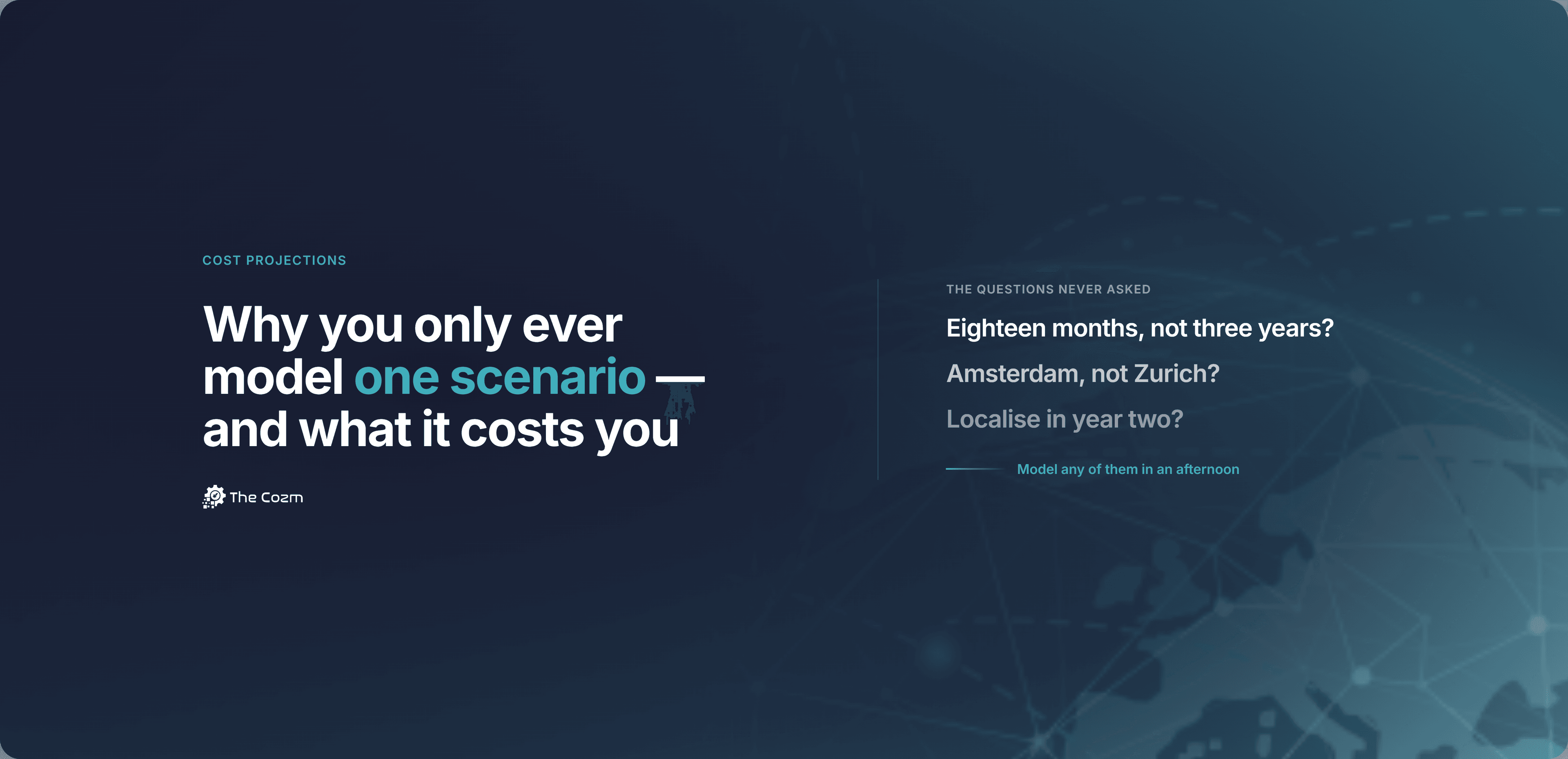
Why you only ever model one scenario — and what it costs you

In 1975 an engineer at Kodak assembled the first digital camera. It weighed nearly four kilos and took 23 seconds to record a single black-and-white image onto a cassette tape. By every measure of the day, it was worse than film.

What eventually changed photography was not image quality. It was that the marginal cost of one more photograph fell to nothing. When a roll of film cost money to buy and money to develop, you framed carefully, took one shot and hoped. Once the second attempt was free, people did not simply take the same pictures more cheaply. They took more of them, looked, and tried again. The photographs got better because failure stopped being expensive.

Assignment cost projections are still in the film era.

Ask for one and, in most organisations, there is a fee attached and a wait of several days. That pricing shapes behaviour long before anyone reads the number. Because each scenario costs something, teams model one — and it is almost always the scenario the business has already settled on. The projection becomes a confirmation exercise rather than a decision tool.

The questions that never get asked are the valuable ones. What if this is eighteen months rather than three years? What does the same package cost in Amsterdam instead of Zurich? What if we localise in year two rather than extending? What if the family joins later? Any of those could change the answer materially. None of them get modelled, because each one carries a price tag and a lead time.

So the real cost of an expensive cost estimate is not the invoice. It is the alternatives nobody tested, and the decision that was taken without them.

The fix is not to negotiate a better rate per projection. It is to move the cost of asking towards zero, so that modelling a scenario is something a mobility manager does in an afternoon rather than something they have to justify requesting.

Get that right and the question changes — from "what will this assignment cost?" to "which version of this assignment is the right one?"
More Insights

See All
banner

It Was Never the Tool. It Was the Brief.

September 16, 2026
TechnologyCompliance

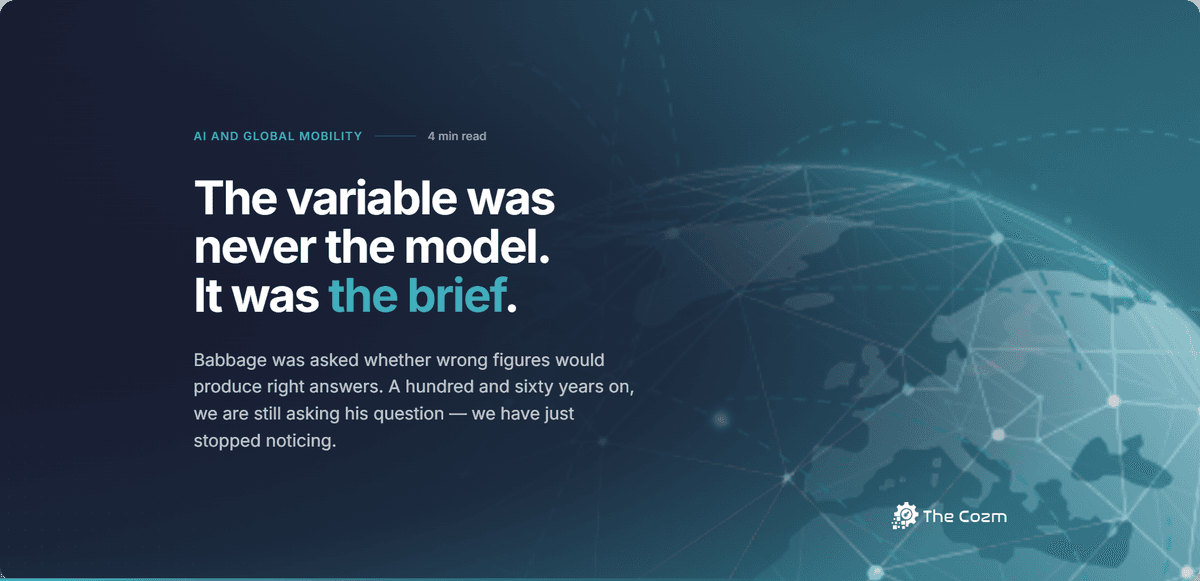
In 1864, Charles Babbage recorded a complaint. Twice, he wrote, he had been asked by parliamentarians — once in each House — whether, if you put wrong figures into his calculating machine, the right answers would come out. He replied that he was not able rightly to apprehend the kind of confusion of ideas that could provoke such a question. A hundred and sixty years later we have machines Babbage could not have imagined, and we are still asking his question. We have simply stopped noticing that we are. Global mobility teams have spent two years being told that AI will transform the function. Many have tried it. They have typed a short instruction into a box, received a generic summary of a policy they wrote themselves, and concluded the technology was oversold. The conclusion is understandable and it is wrong. The variable was never the model. It was the brief. The difference between people getting real value out of these tools and people getting filler is rarely the tool. It is the quality of the input — and that is a learnable skill, not a technical one. Five things change the output immediately. Brief it the way you would brief a new joiner. Nobody tells a first-day hire to "sort the tax thing", so give the role, the situation, the constraints and the audience. Say what good looks like. "A one-page note a CFO will read" produces something entirely different from "explain this". Show it a single example of a strong output. That teaches more than three paragraphs describing one. Ask it to interview you before it answers. "What do you need to know first?" is the fastest way to learn what a good brief contains. Treat the first response as a draft rather than a verdict. The value usually arrives on the second or third pass. None of this requires a course or a licence. It requires the discipline of asking properly, which mobility professionals already practise every time they turn a vague request from the business into a workable instruction. The people who get the most from AI over the next two years will not be the ones with the best tools. They will be the ones who got good at asking.

Read more
banner

From horses to cars: change is hard, standing still is harder

August 26, 2026
ComplianceTechnology

In 1900, the streets of New York and London were dominated by horses. Little more than a decade later, they were dominated by cars. We remember it as a technology story. It is really a story about people, and about how quickly "the way we have always done it" stops being true. The trades that went were real. Farriers, grooms, stable hands, harness makers, carriage builders — skilled work, often handed down through families. Those people were not wrong to be worried, and it would have been easy to argue the change should slow down. What is hard to see from inside the moment is what comes next. Mechanics, drivers, road engineers, fuel distribution, manufacturing, logistics — entire categories of work nobody in 1900 could have described, most of it safer, better paid and less brutal than what it replaced. Global mobility is in the same position now. A large share of what mobility teams do each day is manual: rekeying data between systems, chasing documents, preparing filings, checking a certificate arrived. It is necessary work, and it is going to be automated — not because anyone wants to remove people, but because the technology already exists and the economics are not subtle. The instinct to defend the current process is human. Change is hard. But standing still is harder: slower, more expensive, and it delivers you to the same destination with less control over how you arrive. The better question is not whether the manual work survives. It is what your team does with the time it gets back. Policy design. Advising the business on where to deploy talent. Managing cost and risk before they bite. Looking after people at a genuinely stressful moment in their lives. That work is not going anywhere — and there is nowhere near enough time being spent on it today. Nobody is nostalgic for the stables. The opportunity is to be the profession that drove the change, rather than the one it happened to.

Read more
one trip

One trip, five risks: Why business travel is where compliance breaks

August 19, 2026
TechnologyCompliance

Global mobility teams have, on the whole, got assignments under control — there is a process, a policy, a checklist. Business travel is a different story, and it's where compliance quietly breaks. The problem is that a single business trip can trigger obligations across at least five different regimes at once: corporate tax, through permanent-establishment risk if an employee does the wrong kind of work in the wrong place; posted-worker obligations, with notifications required before travel across much of the EU; social security, where an A1 or certificate of coverage may be needed to avoid paying twice; personal income tax and withholding, once day-count or activity thresholds are crossed; and immigration and right to work, even for short visits. None of this is exotic. What makes it dangerous is who is involved. The person booking the trip is rarely thinking about permanent establishment. The mobility or tax team often does not hear about the trip at all — and if they do, it is after it has happened. By then the exposure is real and retrospective fixes are expensive. Most organisations still manage this by looking backwards: a spreadsheet of trips, a quarterly review, a scramble when an authority asks a question. But compliance assessed after the trip is compliance assessed too late. You can not file a posted-worker notification for a trip that finished last month. The shift that works is to move the check to the point of booking. Assess every trip in real time against the relevant regimes, flag what is required, and trigger the filing before the employee travels. Not more reviews after the fact — fewer surprises in the first place. A simple test: can you say, in seconds, which of your trips last quarter created a compliance obligation, and whether each was met? If the honest answer is 'not without a lot of digging', that gap is where the risk lives — and it is exactly the kind of thing that should be automated.

Read more
UK - India Deal

The UK–India double-contribution deal is live. The saving isn't automatic.

August 6, 2026
ComplianceTechnology

On 15 July 2026, the India–UK Double Contribution Convention came into force as part of the two countries' new trade agreement. For anyone moving staff between the UK and India, it's a genuinely significant — and welcome — change. But the benefit only lands if you handle the paperwork. And that is exactly where programmes trip up. The old position Until now, an Indian employee seconded to the UK received a 52-week exemption from National Insurance; once it ran out, UK contributions began. In the other direction, a UK employee seconded to India kept paying UK National Insurance for 52 weeks while also becoming liable for Indian social security — the classic double-contribution trap, with money flowing into two systems for the same person. What has changed Under the new Convention, "detached" workers can remain in their home country's social security system for up to five years (60 months) and drop out of the host country's scheme entirely. No more double contributions — and a real cash saving for both employer and employee on assignments and longer secondments. The catch The exemption is not automatic. It applies only where the worker holds a valid Certificate of Coverage evidencing that they remain in their home-country system. No certificate, no exemption — and the host-country contributions fall due. For one assignee, that's an administrative task. For a population of assignees and frequent travellers — across a five-year window, with new joiners, extensions and expiries — it becomes a tracking problem. The part that quietly gets missed A certificate obtained late, or allowed to lapse, turns a planned saving into an unplanned liability. And it's exactly the kind of low-visibility admin that spreadsheets handle badly. The organisations that actually capture the benefit will be the ones who treat Certificate of Coverage management as a process to automate, not a form to chase.

Read more