One trip, five risks: Why business travel is where compliance breaks
Global mobility teams have, on the whole, got assignments under control — there is a process, a policy, a checklist. Business travel is a different story, and it's where compliance quietly breaks.
The problem is that a single business trip can trigger obligations across at least five different regimes at once: corporate tax, through permanent-establishment risk if an employee does the wrong kind of work in the wrong place; posted-worker obligations, with notifications required before travel across much of the EU; social security, where an A1 or certificate of coverage may be needed to avoid paying twice; personal income tax and withholding, once day-count or activity thresholds are crossed; and immigration and right to work, even for short visits. None of this is exotic. What makes it dangerous is who is involved. The person booking the trip is rarely thinking about permanent establishment. The mobility or tax team often does not hear about the trip at all — and if they do, it is after it has happened. By then the exposure is real and retrospective fixes are expensive.
Most organisations still manage this by looking backwards: a spreadsheet of trips, a quarterly review, a scramble when an authority asks a question. But compliance assessed after the trip is compliance assessed too late. You can not file a posted-worker notification for a trip that finished last month.
The shift that works is to move the check to the point of booking. Assess every trip in real time against the relevant regimes, flag what is required, and trigger the filing before the employee travels. Not more reviews after the fact — fewer surprises in the first place.
A simple test: can you say, in seconds, which of your trips last quarter created a compliance obligation, and whether each was met? If the honest answer is 'not without a lot of digging', that gap is where the risk lives — and it is exactly the kind of thing that should be automated.
The UK–India double-contribution deal is live. The saving isn't automatic.
August 6, 2026
ComplianceTechnology
On 15 July 2026, the India–UK Double Contribution Convention came into force as part of the two countries' new trade agreement. For anyone moving staff between the UK and India, it's a genuinely significant — and welcome — change.
But the benefit only lands if you handle the paperwork. And that is exactly where programmes trip up.
The old position
Until now, an Indian employee seconded to the UK received a 52-week exemption from National Insurance; once it ran out, UK contributions began.
In the other direction, a UK employee seconded to India kept paying UK National Insurance for 52 weeks while also becoming liable for Indian social security — the classic double-contribution trap, with money flowing into two systems for the same person.
What has changed
Under the new Convention, "detached" workers can remain in their home country's social security system for up to five years (60 months) and drop out of the host country's scheme entirely.
No more double contributions — and a real cash saving for both employer and employee on assignments and longer secondments.
The catch
The exemption is not automatic. It applies only where the worker holds a valid Certificate of Coverage evidencing that they remain in their home-country system.
No certificate, no exemption — and the host-country contributions fall due.
For one assignee, that's an administrative task. For a population of assignees and frequent travellers — across a five-year window, with new joiners, extensions and expiries — it becomes a tracking problem.
The part that quietly gets missed
A certificate obtained late, or allowed to lapse, turns a planned saving into an unplanned liability. And it's exactly the kind of low-visibility admin that spreadsheets handle badly.
The organisations that actually capture the benefit will be the ones who treat Certificate of Coverage management as a process to automate, not a form to chase.
The A1 is (nearly) dead for business travel. Your compliance risk just went up.
August 5, 2026
ComplianceTechnology
The headline everyone shared last month was simple: the EU is scrapping the A1 certificate for business travel. For mobility and reward teams who've spent years filing A1s for every cross-border trip, it sounded like a long-overdue break. Look closer, though, and the picture is the opposite of a break.
First, it isn't law. The European Parliament and Council have only provisionally agreed the exemption; it still needs formal adoption and isn't expected to take effect before autumn 2026. Until then, the A1 remains the required proof of social-security coverage across the single market — so nothing changes for your travellers today.
Second, it's narrow — and it turns on purpose, not just duration. The waiver is aimed at genuinely short business trips (meetings, conferences, internal visits) of around three days within any 30-day window. It is not designed for people posted abroad to perform the actual work, and the construction sector is excluded altogether — so a lot of "real work" travel still needs an A1 regardless of length.
Third, and most importantly, it only touches social security. Posted-worker notifications, immigration permissions and permanent-establishment and tax exposure are entirely unaffected. A "no A1 needed" trip can still trigger three other compliance obligations.
Put those together and the reform doesn't remove work — it moves it. Instead of a simple, blanket rule ("always file an A1"), teams will have to classify every trip — business traveller or posted worker, construction or not — and track a precise three-days-in-thirty threshold, per person, across every EU trip, to know whether an exemption even applies — and then still check the other obligations that haven't gone away.
That's not something a spreadsheet updated after the fact can do. A rolling day-count across a whole travelling population, with alerts before someone crosses the line, is a monitoring problem — and monitoring problems are solved by automation, not effort.
None of this is a reason to slow down on compliance. It's a reason to get the visibility right before the rules change, not after. The organisations that will look smart in autumn 2026 are the ones that can already see, in real time, which travellers are approaching a threshold — and act before it becomes a liability.
That's the kind of problem we think about at The Cozm.
Always happy to compare notes.
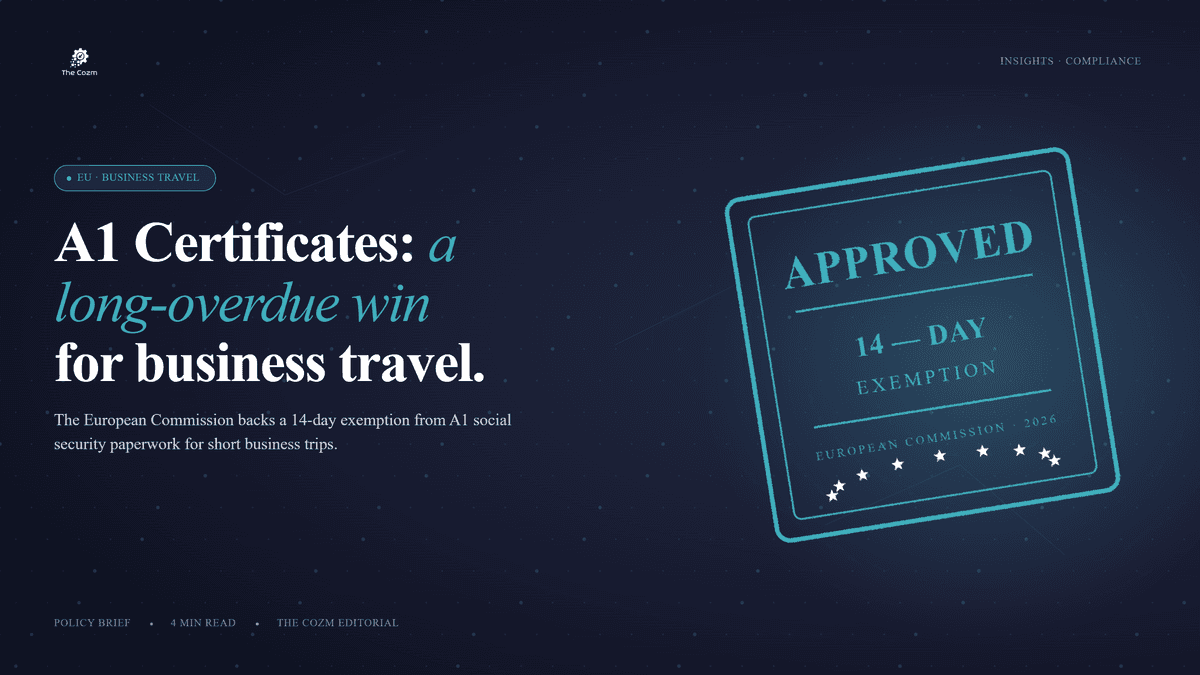
A1 Certificates: A Long-Overdue Win for Business Travel
May 5, 2026
ComplianceTechnology
For anyone who's ever watched a routine business trip grind to a halt over an A1 certificate, last week's news will feel satisfying.
The European Commission has formally backed an exemption from A1 social security certificate requirements for short-term business travel — a change BT4Europe, the pan-European business travel alliance, has been pushing hard for.
The Commission acknowledged the administrative burden the current rules create and confirmed a 14-day exemption is now under active discussion.
The A1 form has been a thorn in the side of business travel compliance since 2010. Required any time an employee crosses an EU border — even for a two-day conference or a client meeting — it creates paperwork friction that bears no real relationship to social security risk. For companies running high volumes of short-duration trips, the cumulative cost and admin load is significant.
The good news: political momentum is building. Cyprus holds the Council Presidency in H1 2026, giving a window for formal agreement. The Commission has also reconfirmed plans for a European Social Security Pass — a digital verification tool that, when it arrives, will transform how A1 compliance is managed in practice.
The important caveats: nothing changes until the regulation is formally adopted, and the exemption won't be a blanket pass. The current proposal carves out specific activities — meetings, conferences, training — while explicitly excluding the provision of services or delivery of goods. That distinction matters. Companies will still need to assess the nature of each trip to determine whether it qualifies, and getting that wrong carries the same risk it always has. The administration may reduce; the diligence cannot.
At Cozm, we've been tracking this closely. Our platform already automates A1 management for business travellers — and when the exemption comes through, we'll be first to reflect it. Until then, we keep your travellers covered.
Watch this space.
Simplifying Cross-Border Work: The EU's e-Declaration Portal for Posted Workers
November 12, 2025
Compliance
The European Union is taking a significant step toward reducing administrative complexity for businesses operating across borders. In November 2024, the European Commission proposed new legislation to establish a digital portal that promises to transform how companies declare posted workers—a process that currently involves navigating 27 different national systems with varying requirements.
Understanding Posted Workers
A posted worker is an employee temporarily sent by their employer to provide services in another EU member state. This practice is fundamental to the EU's freedom to provide services, enabling businesses to fulfill contracts across borders while temporarily deploying their workforce. In 2022, approximately 5 million workers were posted across the EU, a figure that has shown consistent growth in recent years.
Currently, employers face a patchwork of national regulations and declaration requirements when posting workers. Each of the 27 EU countries maintains its own system with distinct information requirements, formats, and procedures. This fragmentation creates substantial administrative burdens and compliance challenges for businesses, particularly small and medium enterprises that may lack dedicated resources to manage these complexities.
The e-Declaration Proposal
The proposed regulation establishes a multilingual electronic public interface connected to the Internal Market Information System (IMI). This voluntary digital portal would allow companies to submit posting declarations through a single, standardized platform rather than dealing with multiple national systems.
The initiative was first announced in the 2020 New Industrial Strategy update and gained momentum through the March 2024 Communication on labour and skills shortages in the EU. The proposal represents the culmination of extensive consultations with member states and stakeholders, including work by a dedicated expert group that concluded in December 2023.
How the System Works
The e-Declaration portal provides a secure web environment where companies can create accounts, manage declarations, and submit information electronically. The standard declaration form captures essential data across approximately 30 data points, including:
Information about the service provider (employer)
Details of the posted worker or workers
Specifics about the posting activity and duration
Contact information for the liaison person in the host country
Information about the recipient of services
Once submitted, declarations are automatically transferred to the IMI system, making the information accessible to competent national authorities for monitoring and enforcement purposes. Member states can also configure the system to send declarations directly to their national back-end systems, ensuring seamless integration with existing infrastructure.
Voluntary Participation Framework
A critical feature of the proposed regulation is its voluntary nature. EU member states are not obligated to participate in the e-Declaration system. Countries wishing to use the platform must notify the European Commission six months before their intended start date, allowing adequate preparation time.
Member states that choose to participate commit to not imposing additional declaration or information requirements beyond those specified in the standard form. This provision aims to prevent the system from becoming another layer of bureaucracy rather than a genuine simplification tool.
Countries retain flexibility to discontinue use of the system if it proves unsuitable for their needs. They can also propose modifications to the standard form to accommodate specific national requirements, subject to Commission approval.
Legislative Progress and Timeline
The proposal has moved through the EU legislative process with notable momentum. The Council adopted its general approach on May 22, 2025, introducing several enhancements to the original proposal. These include functionality for service providers to upload relevant supporting documents and clarifications regarding personal data processing and retention.
The European Parliament's Employment and Social Affairs Committee and Internal Market Committee jointly reviewed the proposal, with rapporteurs presenting their draft report in April 2025. The committees voted on amendments in September 2025, adopting the report with strong support—84 votes in favor against 11 opposed.
Parliament's position strengthens several aspects of the system. It requires that the public interface be free of charge and available in all official EU languages, with translation capabilities to help national authorities understand uploaded documents. The interface should also allow companies to save relevant data for future declarations, reducing repetitive data entry.
Additionally, Parliament specified that information from the e-Declaration portal should be accessible to the European Labour Authority (ELA) and that the system must be compatible with existing national back-end infrastructure. Data retention limits for posting declarations and uploaded documents are also defined more precisely.
With both Council and Parliament having adopted their positions, interinstitutional negotiations can proceed to finalize the regulation.
Expected Benefits
The European Commission estimates significant administrative savings from widespread adoption of the e-Declaration system. Time spent on posting declarations could decrease by approximately 73 percent when companies use the standardized digital form instead of navigating 27 different national systems.
If all member states participate, overall administrative costs for businesses could be reduced by up to 81 percent. These savings contribute directly to the Commission's objective of reducing companies' reporting burden by 25 percent, as outlined in its Communication on long-term competitiveness.
Beyond cost savings, the system promises improved enforcement capabilities. By centralizing declaration data within the IMI framework, national authorities can more effectively monitor compliance with posting rules and coordinate cross-border inspections. This enhanced oversight helps protect posted workers' rights while maintaining fair competition among service providers.
The system also increases transparency. Member states have the option to automatically send copies of declarations to posted workers themselves, ensuring they are informed about the terms and conditions registered for their posting.
Data Protection and Privacy
The proposal establishes appropriate legal grounds for processing personal data in accordance with the General Data Protection Regulation (GDPR) and related EU privacy frameworks. Personal information collected through the e-Declaration portal is used exclusively for authorized purposes related to posting of workers enforcement.
The Council's general approach clarified that personal data of relevant representatives can be processed and retained within the service provider category for longer than the standard 36-month period when permitted by certain national laws. This accommodation addresses practical enforcement needs while maintaining strong data protection principles.
Posted workers have rights to access information about how their data is processed, flag inaccuracies, and request corrections. The system is designed to balance enforcement requirements with fundamental rights to privacy and data protection.
Integration with Broader Initiatives
The e-Declaration portal represents one component of the EU's broader efforts to modernize labor mobility and social security coordination. The Commission has also been developing the European Electronic Social Security Pass (ESSPASS), envisioned as a mobile application providing electronic access to social insurance information.
ESSPASS would digitize the A1 certificate—a crucial document establishing which country's social security system applies to a worker operating in multiple member states. Combined with e-Declaration, these initiatives could substantially streamline the entire posting process, from initial declaration through ongoing compliance verification.
The Council's general approach explicitly calls for the Commission to evaluate the implementation after five years and explore integration possibilities between the posting declaration process and the portable document A1 system.
Industry Perspectives
Business organizations have generally welcomed the proposal as a meaningful step toward reducing administrative complexity. Industry groups like the VDMA (German Engineering Federation) have long advocated for simplified posting procedures, noting the paradox that posting workers to the United States can sometimes be administratively easier than posting within the EU.
However, some stakeholders have raised concerns about the voluntary nature of the system. If only some member states participate, companies may still need to navigate a mix of the e-Declaration portal and traditional national systems, limiting the efficiency gains.
Labor organizations, represented by groups like the European Trade Union Confederation (ETUC), emphasize that simplification must not come at the expense of worker protection. They advocate for robust data collection requirements, adequate retention periods to support criminal investigations, and strong enforcement mechanisms to combat fraud and abuse affecting posted workers.
Challenges and Considerations
The success of the e-Declaration initiative depends heavily on achieving broad participation among member states. With voluntary adoption, there is risk of fragmented implementation where only certain countries use the system, limiting its effectiveness and cost-saving potential.
Technical integration poses another challenge. Member states have invested significantly in their existing national posting declaration systems. Ensuring the e-Declaration portal can interface smoothly with diverse legacy systems requires substantial technical coordination and potentially costly adaptations.
Different member states have varying information requirements based on their specific enforcement needs and legal frameworks. While the standard form includes approximately 30 data points considered essential, some countries may view this as insufficient for effective monitoring. Balancing standardization with legitimate national variations requires careful negotiation.
There are also questions about the system's ability to detect and prevent abuses such as fraudulent postings or schemes designed to circumvent labor protections. The effectiveness of enforcement depends not just on having a digital system, but on adequate resources for inspections and cross-border cooperation among national authorities.
Looking Forward
The e-Declaration portal represents a pragmatic approach to a longstanding administrative challenge in the EU single market. By providing a voluntary common platform while respecting member state sovereignty over enforcement, the proposal seeks to achieve meaningful simplification without forcing a one-size-fits-all solution.
The estimated €3 million cost over the first five years is relatively modest compared to the potential administrative savings for businesses and the enhanced enforcement capabilities for member states. If the system proves successful, it could serve as a model for similar initiatives in other areas requiring cross-border administrative cooperation.
For businesses regularly posting workers across the EU, the e-Declaration portal offers the promise of a more streamlined, predictable process. Rather than maintaining expertise on 27 different national systems, companies could manage their posting obligations through a single, multilingual interface.
For posted workers themselves, the system should contribute to better protection of their rights through improved transparency and more effective enforcement. Clear, standardized declarations make it easier for workers to understand the terms of their posting and for authorities to verify compliance with applicable rules.
As the legislation moves toward final adoption, attention will focus on which member states choose to participate and how quickly the system can be implemented. The Commission's commitment to providing technical support and training will be crucial for ensuring smooth rollout and encouraging broad adoption.
The e-Declaration portal may not solve all challenges related to posting of workers, but it represents meaningful progress toward making cross-border service provision more efficient while maintaining high standards for worker protection. In an increasingly integrated European economy, such pragmatic innovations are essential for balancing competitiveness with social protections.
Practical Implications for Businesses
Companies that regularly post workers should begin preparing for this transition now. This includes:
Reviewing current posting procedures and identifying opportunities for standardization
Ensuring HR and compliance teams understand the upcoming changes
Evaluating whether the e-Declaration system, once implemented, would be beneficial for their specific posting patterns
Maintaining awareness of which member states join the system and when
Preparing to update internal policies and training materials as the regulation enters into force
While the voluntary nature of the system means companies may still need to manage some national variations, the e-Declaration portal represents a significant step toward simplifying one of the more administratively complex aspects of operating in the EU single market.