Lost in the handover: what a Mars orbiter teaches travel compliance
On 23 September 1999, NASA’s Mars Climate Orbiter fired its engine to enter orbit around Mars and was never heard from again. The cause, confirmed within a week, was almost embarrassingly simple. The spacecraft team in Colorado supplied thruster data in pound-force seconds. The navigation team in California treated it as newton-seconds. Every small thruster firing was underestimated by a factor of 4.45, and across a nine-month cruise the error accumulated until the orbiter arrived far too low.
What makes the story worth retelling is NASA’s own conclusion. As Dr Edward Weiler, then NASA’s Associate Administrator for Space Science, put it: “The problem here was not the error, it was the failure of NASA’s systems engineering, and the checks and balances in our processes to detect the error.” Both teams were capable. The failure sat in the handover between them.
Business travel compliance has the same shape. A trip passes through a booking tool, an approver, HR data, a compliance assessment, often an external tax or immigration provider, and payroll. Each of those steps is usually done competently. The risk accumulates where information passes from one to the next.
In our world the mismatch is rarely a unit of measurement. It is a definition. Is a day a calendar day, a working day, or any day spent in the country? Is a piece of work a trip, a project or an assignment? Is the employer the contracting entity or the one that pays and benefits? Two systems can share a field and still disagree about what it means.
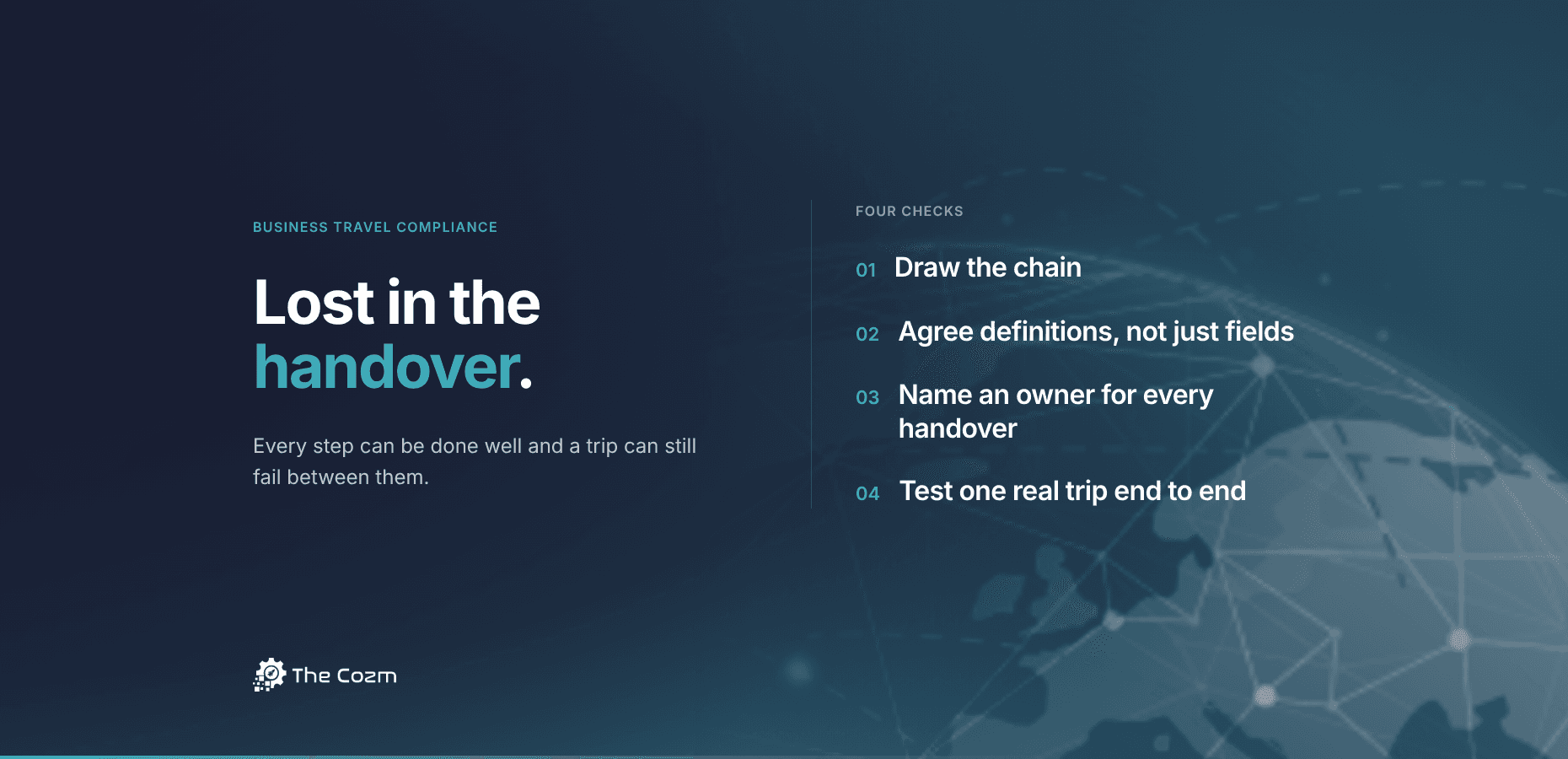
Four checks help. Draw the chain, so every system and provider a trip touches is visible. Agree definitions, not just data fields. Give every handover a named owner. And test end to end, by running one real trip through the whole chain rather than checking each team’s piece in isolation.
This is also why partnerships succeed or fail. At The Cozm we deliver business travel compliance alongside partners such as Santa Fe Relocation, and the work that matters most is not either firm’s part. It is the handover. A partnership isn’t two good firms. It’s one clean handover.
So where are the seams in your travel compliance chain, and who owns them?