the cozm logo
Global Mobility Event
November 18, 2026

Count the missing: what a wartime statistician teaches global mobility about its data

During the Second World War, the statistician Abraham Wald worked with the Statistical Research Group at Columbia University on a deceptively simple question: where should aircraft carry more armour? The obvious evidence was the damage on planes returning from missions. As the story is usually told, the instinct was to reinforce the areas with the most bullet holes.

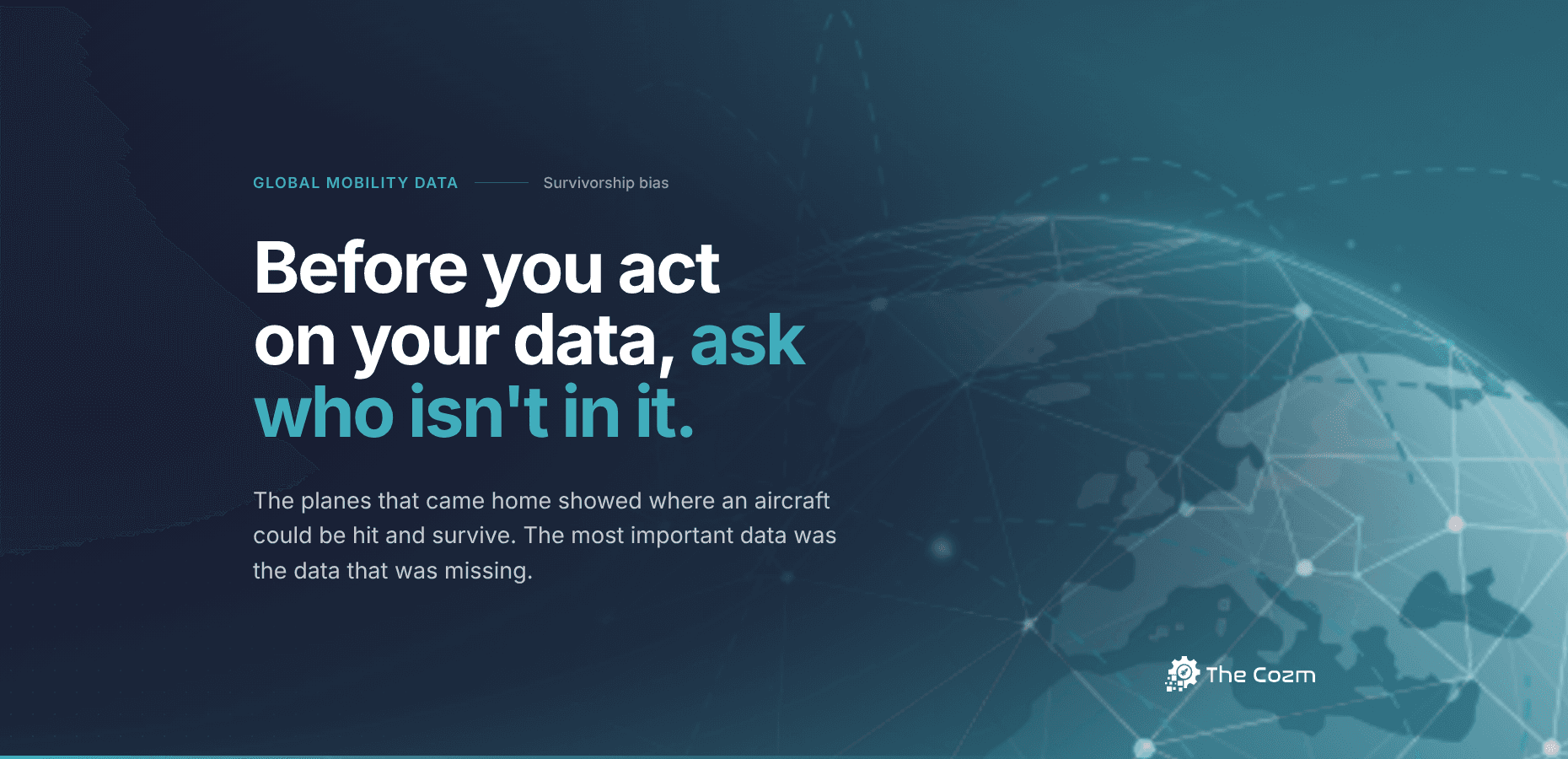
Wald saw the flaw. Every plane being studied had made it home. Their damage showed where an aircraft could be hit and survive. The planes hit elsewhere, the engines among them, mostly never returned to be counted. The most important data was the data that was missing.

We now call this survivorship bias, and global mobility programmes are full of it.

Assignment surveys reach the people who completed their assignments, not the early returners or those who resigned after coming home. Programme data records the moves that went ahead, but rarely the offers that were declined or the moves that were cancelled, which often say more about whether a policy works. Business travel compliance reports cover the trips that someone registered; the exposure sits in the trips nobody mentioned. And repatriation is usually judged when the assignment ends, while the real loss tends to appear later, when people leave.

None of these gaps is hard to close once you see it. Record the moves that don’t happen as carefully as the ones that do. Survey people who left early, not just those who finished. Look for the trips that are missing from your compliance data, not only the ones that are in it. Measure repatriation success a year after return, not on the day.

This is why Cozm Unity keeps every request and scenario on record, including the moves the business decides not to make.

Wald’s lesson is as useful now as it was then: before you act on your data, ask who isn’t in it.

More Insights

See All
banner

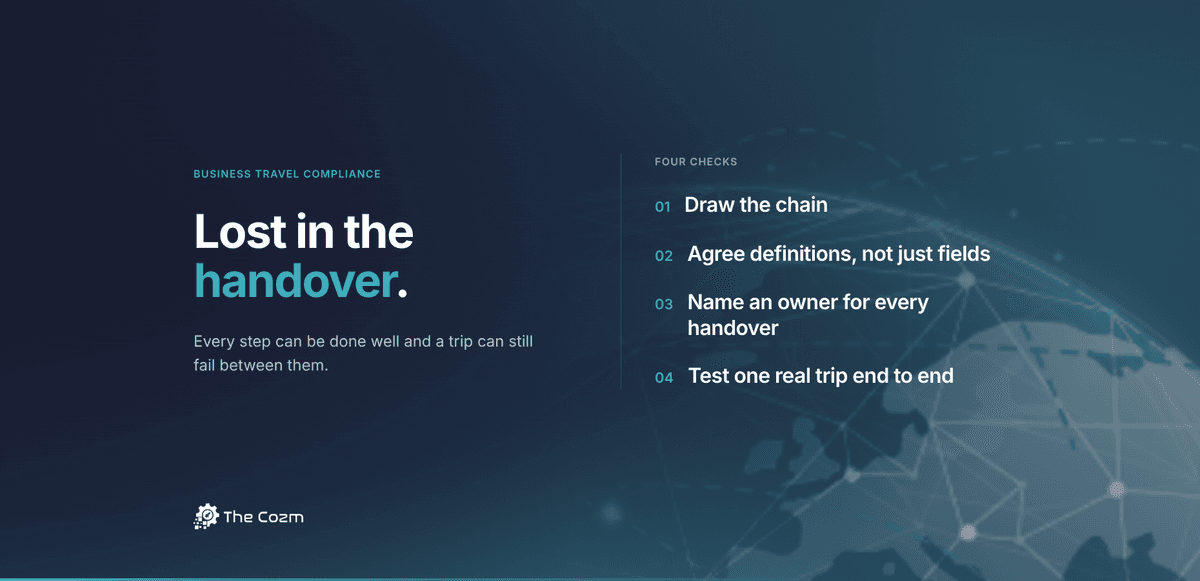
Lost in the handover: what a Mars orbiter teaches travel compliance

November 12, 2026
TechnologyCompliance

On 23 September 1999, NASA’s Mars Climate Orbiter fired its engine to enter orbit around Mars and was never heard from again. The cause, confirmed within a week, was almost embarrassingly simple. The spacecraft team in Colorado supplied thruster data in pound-force seconds. The navigation team in California treated it as newton-seconds. Every small thruster firing was underestimated by a factor of 4.45, and across a nine-month cruise the error accumulated until the orbiter arrived far too low. What makes the story worth retelling is NASA’s own conclusion. As Dr Edward Weiler, then NASA’s Associate Administrator for Space Science, put it: “The problem here was not the error, it was the failure of NASA’s systems engineering, and the checks and balances in our processes to detect the error.” Both teams were capable. The failure sat in the handover between them. Business travel compliance has the same shape. A trip passes through a booking tool, an approver, HR data, a compliance assessment, often an external tax or immigration provider, and payroll. Each of those steps is usually done competently. The risk accumulates where information passes from one to the next. In our world the mismatch is rarely a unit of measurement. It is a definition. Is a day a calendar day, a working day, or any day spent in the country? Is a piece of work a trip, a project or an assignment? Is the employer the contracting entity or the one that pays and benefits? Two systems can share a field and still disagree about what it means. Four checks help. Draw the chain, so every system and provider a trip touches is visible. Agree definitions, not just data fields. Give every handover a named owner. And test end to end, by running one real trip through the whole chain rather than checking each team’s piece in isolation. This is also why partnerships succeed or fail. At The Cozm we deliver business travel compliance alongside partners such as Santa Fe Relocation, and the work that matters most is not either firm’s part. It is the handover. A partnership isn’t two good firms. It’s one clean handover. So where are the seams in your travel compliance chain, and who owns them?

Read more
banner

Before you move the fence, ask why it is there

November 5, 2026
ComplianceTechnology

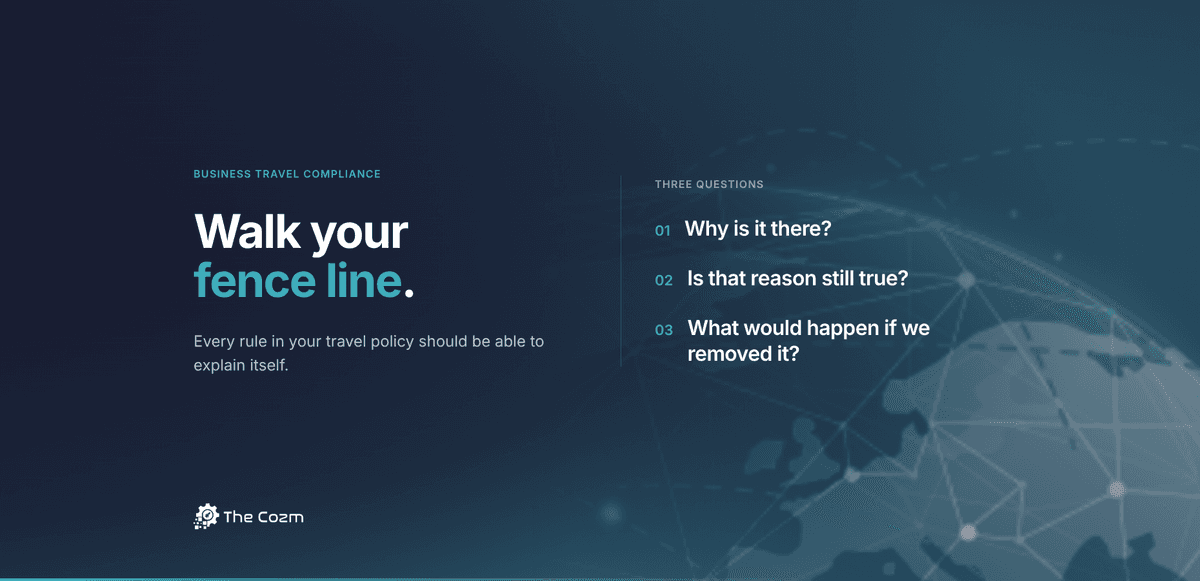
In his 1929 book The Thing, G.K. Chesterton described a fence across a road. One reformer wants it gone because he can’t see the point of it. Chesterton’s answer is that this is exactly why it can’t go yet: first find out why someone put it there. The idea, now known as Chesterton’s fence, is usually used to defend the status quo. But it works just as well the other way round. A rule nobody can explain is not being protected. It is just being kept. Business travel compliance policies are full of fences. Many were written years ago, for a smaller travel footprint and a quieter regulatory world. Since then, posted worker notifications have spread across Europe, enforcement has become more digital, and the EU has just agreed reforms to the social security rules that sit behind the A1. Yet the policy often reads exactly as it did on the day it was signed off. Some common fences are worth testing. “Short trips don’t need anything.” Under the current EU rules there is no minimum trip length for social security purposes. The A1 question technically arises from the first day of work in another country, and the agreed reforms will reshape it again. “We’re fine under 183 days.” The 183-day test belongs to tax treaties. Immigration permission, social security and posted worker notifications each have their own rules, and none of them is measured against 183 days. “Tell us before you travel.” Here the fence may be doing its job. Several countries expect notifications to be made before work begins, so advance notice is not bureaucracy for its own sake. If the reason is good, the policy should say what it is, so travellers take it seriously. A simple review asks three questions of every rule. Why is it there? Is that reason still true? What would happen if we removed it? Where nobody can answer the first, the rule needs work. Where the answer to the second is no, it needs replacing. The goal is not a stricter policy. It is a policy in which every rule can explain itself to a traveller, a finance director and a regulator. That is the approach behind The Cozm’s business travel compliance platform: rules that are current, sourced and applied consistently, trip by trip. So, when did you last walk your fence line?

Read more
banner

The order was clear. To the man who wrote it.

October 28, 2026
ComplianceTechnology

On 25 October 1854, at Balaclava, Lord Raglan watched from high ground as Russian troops began to remove captured British guns. He ordered his cavalry to advance and “try to prevent the enemy carrying away the guns.” To Raglan, the meaning was obvious. He could see the guns. Lord Lucan, commanding the cavalry from the valley floor, could not. The only guns he could see were a Russian battery at the far end of the valley. The Light Brigade was sent down it, into fire from three sides. Who was to blame is still debated, but the root of the disaster is not: the order assumed its reader shared the writer’s view. With AI, context is everything, and missing context is the most common reason AI gives poor answers in global mobility. We ask what feels like a clear question, such as “does this trip need an A1?” or “what will this assignment cost?”, and forget how much we know that the tool doesn’t. We know the employee is tax-equalised, which policy applies, what they will actually be doing in the host country and why the business is asking. The AI sees one sentence. It fills the gaps with assumptions and answers with confidence. Three habits close most of the gap: Share the facts you take for granted. Who is travelling, from where to where, for how long and, above all, what they will be doing. Attending a meeting and delivering a service can lead to very different compliance outcomes. Share your rules. Your policy, thresholds and definitions. Words like “days”, “resident” and “business trip” mean different things in different rules and different organisations. Say what the answer is for. A quick yes or no for a traveller, a cost estimate for a hiring manager and a risk summary for the board are different jobs. Better still, use AI that works where the context already lives, inside the case, with the policy, the history and the travel data to hand. That is the difference between AI beside the work and AI inside it, and it is the principle behind how The Cozm builds its platform. AI tools are now good enough that most poor answers are a context problem, not a capability problem. Context is everything. Before you blame the tool, check what it could see.

Read more
banner

History remembers who went first

October 21, 2026
ComplianceCompany newsTechnology

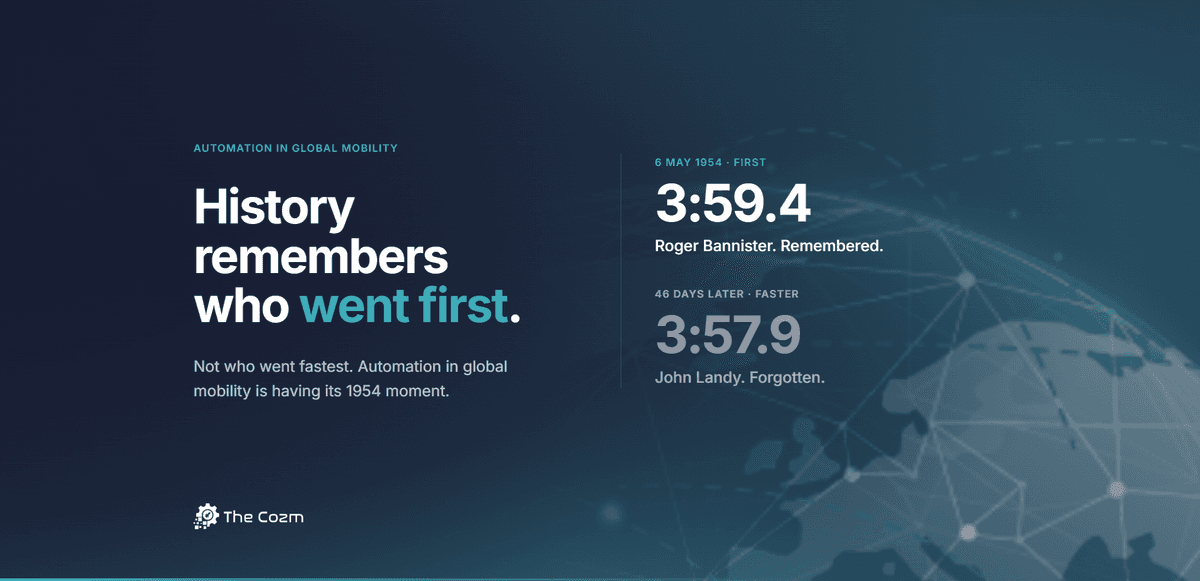
On 6 May 1954, Roger Bannister ran the first mile under four minutes. Everyone remembers that. Forty-six days later, in Turku, Finland, John Landy ran it faster, in 3:57.9. Almost nobody remembers him. Within a few years, dozens of runners had broken four minutes. Two lessons come from one race. Once someone proves a thing can be done, the field moves quickly. And history remembers who went first, not who went fastest. I have been thinking about Landy this week for two reasons. A year ago I came out of retirement, after 17 years as a Big 4 global mobility partner, to join The Cozm. And last week our CEO, Ben Oghene, was named Global Mobility Professional of the Year at the FEM EMEA EMMAs. That matters beyond our team. A global mobility professional was recognised not for advising around the problem, but for building the thing that fixes it. Four lessons from my first year back: Most "complex" mobility work is a rule nobody has written down. Writing it down is most of the work of automating it. Pilot before you write the policy. Three weeks of live trips will teach you more than three months of workshops. The real question is not "can this be automated?" but "who owns the decision once it is?" Clients do not buy technology. They buy certainty. The technology is how you deliver it at scale. Automation in global mobility is having its 1954 moment. The proof is there, and the field is about to move. The teams that go first will be the ones people remember. The rest risk being John Landy: faster, but forgotten. If you want to see what going first looks like, join our first AI in Mobility session, "Automation of Global Mobility", on Monday 26 October at 15:00 UK. Details and places are at thecozm.com/events/ai-in-mobility.

Read more