the cozm logo
Global Mobility Event
June 22, 2025

How Agentic AI Is Transforming Global Mobility

In the past, building enterprise technology was often a slow and costly endeavour. Teams would spend months (if not years) and significant budgets implementing rigid software platforms, only to find them clunky and hard to change. Today, a new paradigm is emerging. Recent advances in artificial intelligence (AI)– from powerful generative models to agentic AI (autonomous, goal-driven AI "agents" that can act on our behalf) – are transforming how technology gets built. Development cycles are accelerating, costs are coming down, and solutions are more customisable than ever. The best part? Modern tech is being built with users, not pushed onto them.

Speed and Cost Have Changed

Generative AI and coding agents now handle tasks like code writing, testing, and documentation — allowing ideas to move from concept to working solution in days, not months. This drastically reduces the cost of development and iteration.

Instead of waiting through long development cycles or vendor change requests, teams can experiment, adjust, and roll out improvements quickly — building tech that evolves with your needs in real time.

No More One-Size-Fits-All

Contrast this with the old world of legacy enterprise systems. Traditional HR and global mobility platforms often took enormous effort to customise (if they were customisable at all). Organisations stuck on outdated systems find themselves pouring resources into just keeping those systems running - customisation came with high costs and delays. That does not work in global mobility, where every assignment, policy, and location is different and requirements are ever-changing.

A recent survey found that IT departments spend 55% of their tech budgets on maintenance – and only 19% on innovation. No wonder updating a legacy application is 2–5 times more expensive (and slower) than updating a modern one, simply because older systems are so hard to modify. These inflexible platforms were not built to adapt to each organisation's unique needs, leading to costly workarounds and one-size-fits-all processes that frustrate users.

AI enables modular, responsive systems. Agentic workflows can adjust to how you operate, and even surface process improvements proactively. Tech no longer dictates your way of working — it supports it.

Organisations can deliver more tailored user experiences without the traditional vendor customisation fees or endless developer hours, because AI makes adapting the software faster and easier.

Why It Matters for Global Mobility?

Managing an international relocation or expatriate assignment involves countless moving parts: immigration visas, work permits, tax compliance, shipping belongings, finding housing and schools – all coordinated among HR, employees, and service providers. It is exactly the kind of process that used to require heavy manual oversight or clunky legacy tools. These are not simple checklists; they are dynamic, high-stakes processes. AI is poised to reinvent this experience.

AI is now capable of driving core mobility workflows:

  • Immigration agents track policy changes, conduct assessments, pre-fill forms, and monitor case progress.
  • Tax agents simulate outcomes and flag compliance issues.
  • Relocation assistants match employee needs with housing or schooling options in line with company policy.

In a traditional model, each of those bullet points might have involved separate systems or manual coordination. These tools do not remove the human touch — they amplify it. Now, an integrated AI-powered mobility platform can orchestrate them almost like a well-trained team of digital assistants. The impact is profound: mobility professionals and HR teams are freed from chasing paperwork and micromanaging tasks, and can focus on strategic talent planning and meaningful human connections rather than drowning in logistics.

Built with You, Not Pushed on You

The real shift is in mindset. The future for global mobility tech and mobility leaders is optimistic: by embracing AI and agentic workflows, we can build solutions faster, at lower cost, and with far more alignment to what users actually need. We are moving away from the era of inflexible, IT-driven systems toward an era of collaborative technology – where building a new workflow might feel less like a massive IT project and more like working with a smart colleague.

Instead of technology being rolled out to you, it now should be built with you. AI enables co-creation — where mobility leaders and tech teams can shape solutions together, prototype ideas quickly, and adapt workflows based on real-time needs.

The future of global mobility tech is fast, flexible, and user-driven. It is not about replacing your team — it is about giving them better tools. And that starts by building technology with you, not pushed on you.

This is what we truly believe in at The Cozm. Unsure where to start your AI-powered digitalisation journey? Book a free one-hour discovery session with The Cozm. We will map out quick-win use cases that boost programme efficiency and let you focus on what really matters. Bring the ideas you thought were impossible—we will explore them together and turn them into practical mobility solutions.
More Insights

See All
banner

History remembers who went first

October 21, 2026
ComplianceCompany newsTechnology

On 6 May 1954, Roger Bannister ran the first mile under four minutes. Everyone remembers that. Forty-six days later, in Turku, Finland, John Landy ran it faster, in 3:57.9. Almost nobody remembers him. Within a few years, dozens of runners had broken four minutes. Two lessons come from one race. Once someone proves a thing can be done, the field moves quickly. And history remembers who went first, not who went fastest. I have been thinking about Landy this week for two reasons. A year ago I came out of retirement, after 17 years as a Big 4 global mobility partner, to join The Cozm. And last week our CEO, Ben Oghene, was named Global Mobility Professional of the Year at the FEM EMEA EMMAs. That matters beyond our team. A global mobility professional was recognised not for advising around the problem, but for building the thing that fixes it. Four lessons from my first year back: Most "complex" mobility work is a rule nobody has written down. Writing it down is most of the work of automating it. Pilot before you write the policy. Three weeks of live trips will teach you more than three months of workshops. The real question is not "can this be automated?" but "who owns the decision once it is?" Clients do not buy technology. They buy certainty. The technology is how you deliver it at scale. Automation in global mobility is having its 1954 moment. The proof is there, and the field is about to move. The teams that go first will be the ones people remember. The rest risk being John Landy: faster, but forgotten. If you want to see what going first looks like, join our first AI in Mobility session, "Automation of Global Mobility", on Monday 26 October at 15:00 UK. Details and places are at thecozm.com/events/ai-in-mobility.

Read more
banner

The Tools Are Here. The Method Comes Next.

September 30, 2026
Company newsTechnology

The first commercial typewriter went on sale in 1874. The technique that made it transformative did not arrive until 1888. For those fourteen years, most people used the machine in the obvious way: hunting for each key, eyes moving constantly between keyboard and page. It was quicker than handwriting, and that was about all anyone could say for it. Then, on 25 July 1888, a court stenographer named Frank McGurrin took part in a public typing contest in Cincinnati against a rival typist, Louis Traub. McGurrin had taught himself to type without looking at the keys — he had memorised the keyboard, and kept his eyes on the copy he was transcribing. He won decisively, and the method he demonstrated spread from there into schools and commercial colleges. The productivity leap everyone credits to the typewriter did not come from the typewriter. It came from a method, invented by one person, proved in public, and then taught. Global mobility is in the equivalent of those fourteen years with AI. The tools are on the desk. Most people have an account. Very few have been shown a method — how to brief a task properly, what to check before trusting an output, which jobs to hand over and which to keep. So they try it, get a mediocre result, and conclude the technology was oversold. The technology was not oversold. The training simply has not happened yet. What closes the gap is unglamorous. One real task you do every week. Twenty minutes on it, regularly. A note of the briefs that worked. Someone better than you to watch. And a tolerance for being slower before you are faster, because every change of method costs something before it pays. None of that requires permission, budget, or a transformation programme. It requires deciding that being a beginner again is acceptable. AI in Mobility is The Cozm's online forum for mobility professionals. Session 1, Automation of Global Mobility, runs on Monday 26 October at 15:00 UK, covering what can be automated, where human judgement still matters, and the skills worth building for 2027. Session 2, on international project workers, follows on Wednesday 18 November. Request a place at thecozm.com/events/ai-in-mobility.

Read more
banner

Global Mobility Needs Its Own Lloyd’s List

September 23, 2026
TechnologyCompliance

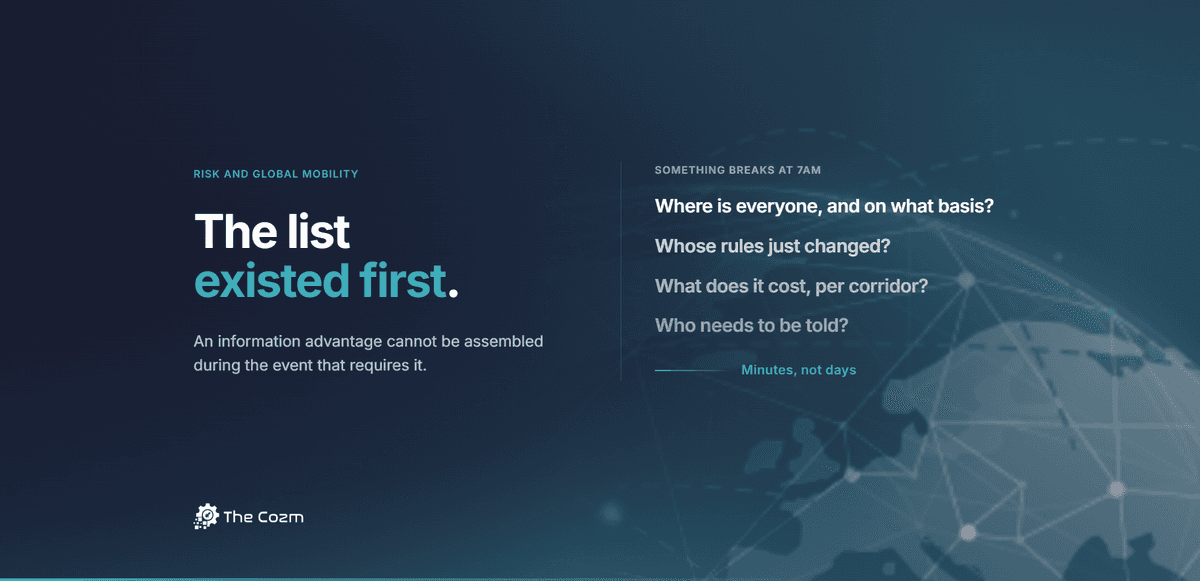
In 1686 Edward Lloyd opened a coffee house near the Thames. What made it the most important room in London was not the coffee. Lloyd began collecting shipping intelligence — which vessels had sailed, which were overdue, which had been taken or lost — and circulating it among the merchants and underwriters who gathered there. By 1734 it had become Lloyd's List, which is still published today. Those merchants traded through war, blockade, privateering and weather, with no way of seeing over the horizon. The ones who prospered were not braver than their competitors. They had better information, sooner. That is what an information advantage buys: not certainty, but the ability to price a risk that everyone else has to decline, and to keep moving while others wait for news. Global mobility now operates in a comparable world. Tariffs redraw supply chains, and headcount follows them. Immigration policy is tightening towards local hiring in market after market. Sanctions and conflict close corridors with little notice. None of it is forecastable. All of it is survivable, provided you can see your own position clearly and quickly. The test is simple. When something breaks at seven in the morning, how long does it take to answer four questions? Where is every mobile employee, and on what legal basis are they there? Which of them are in a country whose rules have just changed? What does that change cost, per person and per corridor, and how fast can it be re-modelled? And who needs to be told, with evidence that they were told? If the honest answer involves several days and a spreadsheet, that is not a resourcing problem. It is the absence of a list. The uncomfortable part is that an information advantage cannot be assembled during the event that requires it. The merchants at Lloyd's did not begin collecting shipping news on the morning the fleet failed to arrive. The list existed first, which was the entire point. Keeping your head when those around you are losing theirs is not a character trait. It is knowing something they do not.

Read more
banner

It Was Never the Tool. It Was the Brief.

September 16, 2026
TechnologyCompliance

In 1864, Charles Babbage recorded a complaint. Twice, he wrote, he had been asked by parliamentarians — once in each House — whether, if you put wrong figures into his calculating machine, the right answers would come out. He replied that he was not able rightly to apprehend the kind of confusion of ideas that could provoke such a question. A hundred and sixty years later we have machines Babbage could not have imagined, and we are still asking his question. We have simply stopped noticing that we are. Global mobility teams have spent two years being told that AI will transform the function. Many have tried it. They have typed a short instruction into a box, received a generic summary of a policy they wrote themselves, and concluded the technology was oversold. The conclusion is understandable and it is wrong. The variable was never the model. It was the brief. The difference between people getting real value out of these tools and people getting filler is rarely the tool. It is the quality of the input — and that is a learnable skill, not a technical one. Five things change the output immediately. Brief it the way you would brief a new joiner. Nobody tells a first-day hire to "sort the tax thing", so give the role, the situation, the constraints and the audience. Say what good looks like. "A one-page note a CFO will read" produces something entirely different from "explain this". Show it a single example of a strong output. That teaches more than three paragraphs describing one. Ask it to interview you before it answers. "What do you need to know first?" is the fastest way to learn what a good brief contains. Treat the first response as a draft rather than a verdict. The value usually arrives on the second or third pass. None of this requires a course or a licence. It requires the discipline of asking properly, which mobility professionals already practise every time they turn a vague request from the business into a workable instruction. The people who get the most from AI over the next two years will not be the ones with the best tools. They will be the ones who got good at asking.

Read more